You are flossing or checking your smile in the mirror and spot it: a small black dot on a back tooth, or a dark line running along a groove. It does not hurt, and it may have been there for a while, but now you cannot stop wondering whether it is just a stain or a hole starting to form.
Black spots on teeth are common, and many of them are harmless. Others are an early sign of decay that is easier to treat the sooner it is found. There are some practical clues that help you tell the two apart, and a clear point at which a dentist should take a look.
The short answer: A black spot on a tooth can be a harmless surface stain, a stained groove or an old filling, but it can also be a cavity. Stains are usually smooth, hard and unchanged over time, while decay often feels rough, catches floss, grows or causes sensitivity. Because a small dark spot can hide decay underneath, only a dentist can tell for sure.
Common causes of a black spot on a tooth
Dark spots can come from the surface of the tooth or from inside it. The most common causes are:
- Surface stains. Coffee, tea, red wine, cola, tobacco and some mouthwashes or iron supplements can leave dark deposits, especially in grooves and along the gumline.
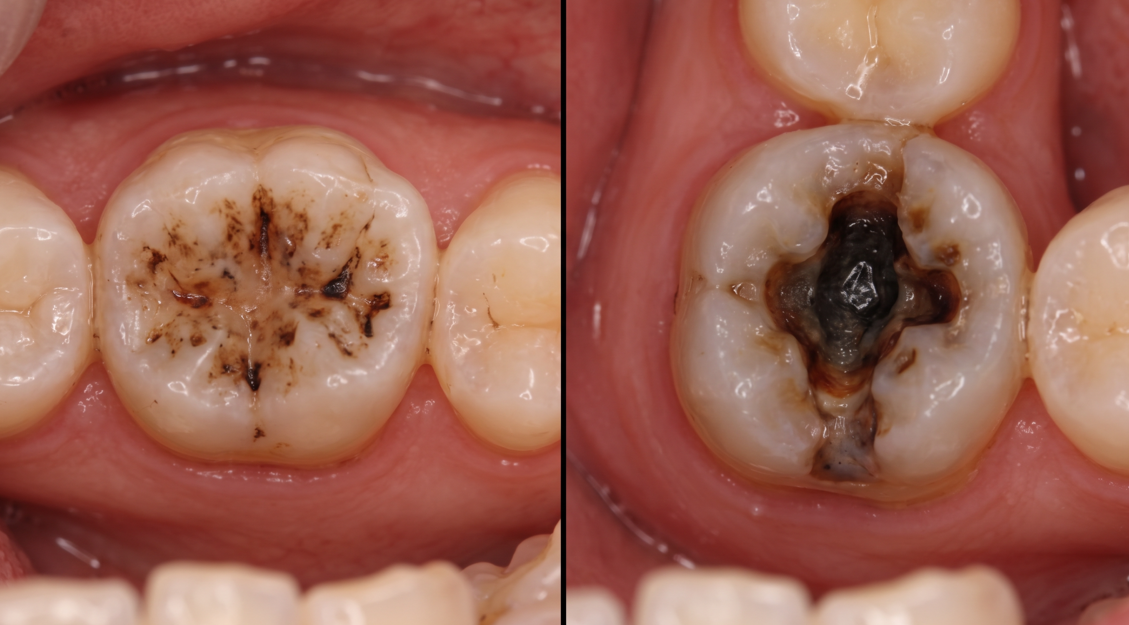
- Stained pits and fissures. The chewing surfaces of molars have deep grooves that pick up pigment easily. A thin dark line in a groove is often just stain.
- Tartar. Hardened plaque is usually yellowish, but tartar near or below the gumline can look dark brown or black.
- Tooth decay. A cavity can appear as a brown or black spot, sometimes with a chalky white rim around it.
- Arrested decay. Sometimes an old lesion stops progressing and hardens. It stays dark but is no longer active.
- Old fillings. Silver-coloured fillings, or the edges around them, can look dark or black through the enamel.
If a whole tooth turns grey or dark, especially after a knock or injury, that is a different situation and should also be checked by a dentist.
Signs that point more towards a stain
A spot is more likely to be a harmless stain when:
- It is smooth and glossy, with no rough edge or visible hole
- It feels hard and does not catch floss
- Similar marks appear on several teeth, often in the same pattern
- It has looked the same for months
- You drink a lot of coffee, tea or red wine, or you smoke
- There is no sensitivity, pain or bad taste in that area
Surface stains often fade or disappear after a professional cleaning and polish, which is one of the simplest ways to find out what you are dealing with.
Signs that point more towards a cavity
Decay is more likely when the spot:
- Looks or feels rough, soft or slightly sunken
- Catches or shreds floss in the same place every time
- Traps food repeatedly
- Is getting larger or darker over time
- Has a chalky white or grey border around it
- Sits between two teeth or right next to the edge of a filling
- Comes with brief sensitivity to sweet, cold or hot foods
No single sign proves a cavity, but the more of these you notice, the sooner it makes sense to book a dental visit.
Why it is hard to tell at home
A black spot on the surface does not show how deep the problem goes. Decay can start in a tiny opening and then spread more widely in the softer layer underneath, so a dot that looks small may sit on top of a larger cavity. Cavities between teeth are often invisible in a mirror altogether.
To decide, a dentist looks at the tooth under good light, checks the surface gently and, when needed, takes an X-ray to see what is happening inside. Some dark spots turn out to be stable, arrested decay that only needs monitoring, while others need treatment. A free online teeth scanner can help you decide whether a spot deserves a closer look, but it cannot replace that examination.
What to do if you notice a black spot
Whatever the cause, these steps are sensible:
- Do not scrape it. Picking at the spot with a pin, toothpick or other sharp object can damage the enamel and gums.
- Brush twice a day with fluoride toothpaste and clean between your teeth every day with floss or interdental brushes.
- Cut down how often you have sugary or acidic food and drinks, since frequent snacking keeps teeth under acid attack.
- Do not rely on whitening products. They may lighten surface stains, but they do not treat decay and can make it harder to notice changes.
- Book a checkup. Depending on what the dentist finds, the answer may be a professional cleaning, monitoring over time, a fissure sealant or a small filling.
See a dentist urgently if you have strong or throbbing tooth pain, pain that wakes you at night, swelling of the gum or face, pus or a bad taste, fever, or a broken tooth. These signs suggest more than a simple spot and should not wait.
Check your teeth free in 30 seconds
Still not sure whether that black spot is a stain or something more? Take a clear photo of your teeth and upload it to DentalAI's free AI dental check. In about 30 seconds you get an AI screening that highlights areas worth attention, and you can then talk to a real dentist online for free about what you see and what to do next.
This article is for general information only and is not a diagnosis. It does not replace an examination by a licensed dentist. If you have pain, swelling or fever, contact a dentist or emergency services.